Start with nothing
Describe your audience and Candor searches for published data: government statistics, industry reports, peer-reviewed research, professional association data. Specific, citable sources, not generic AI knowledge.
Candor builds synthetic users from real evidence you can open and check, then lets you interview them. Use it to sharpen your questions before you spend a recruiting budget.
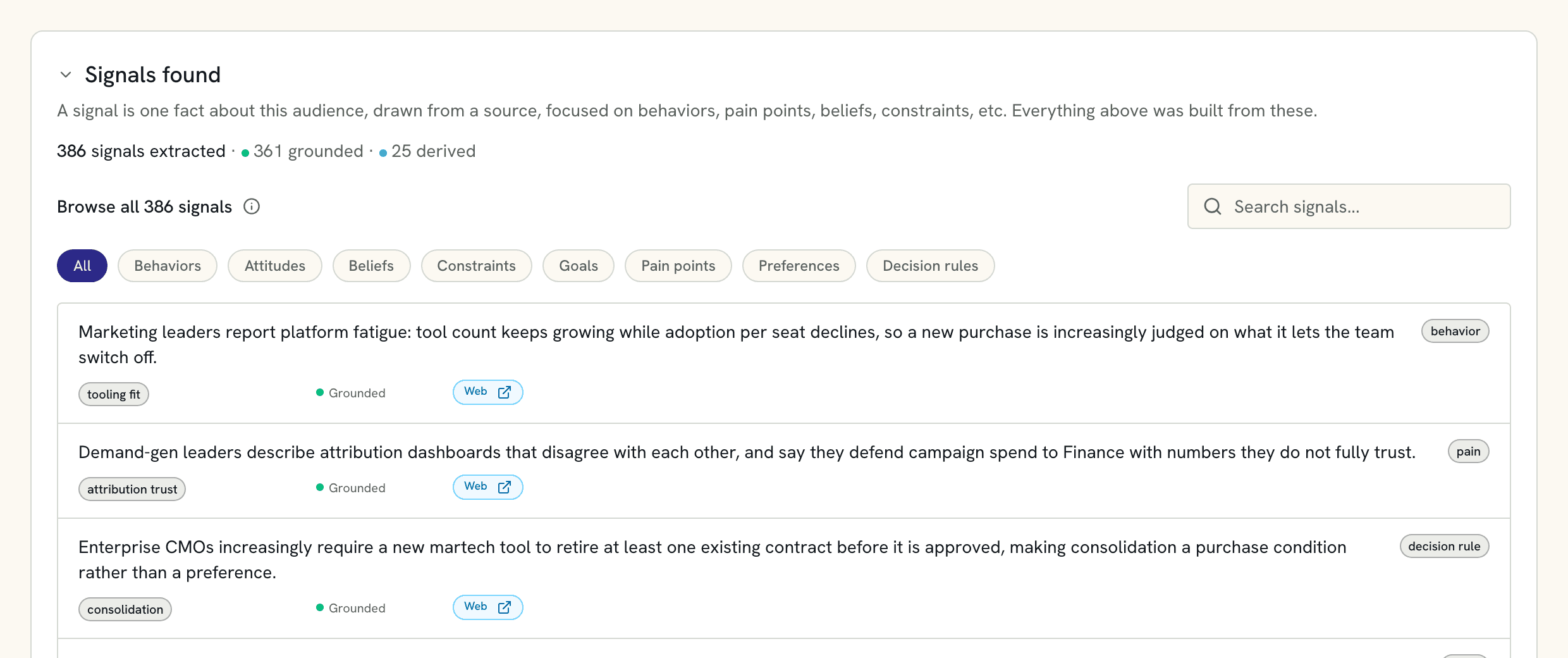
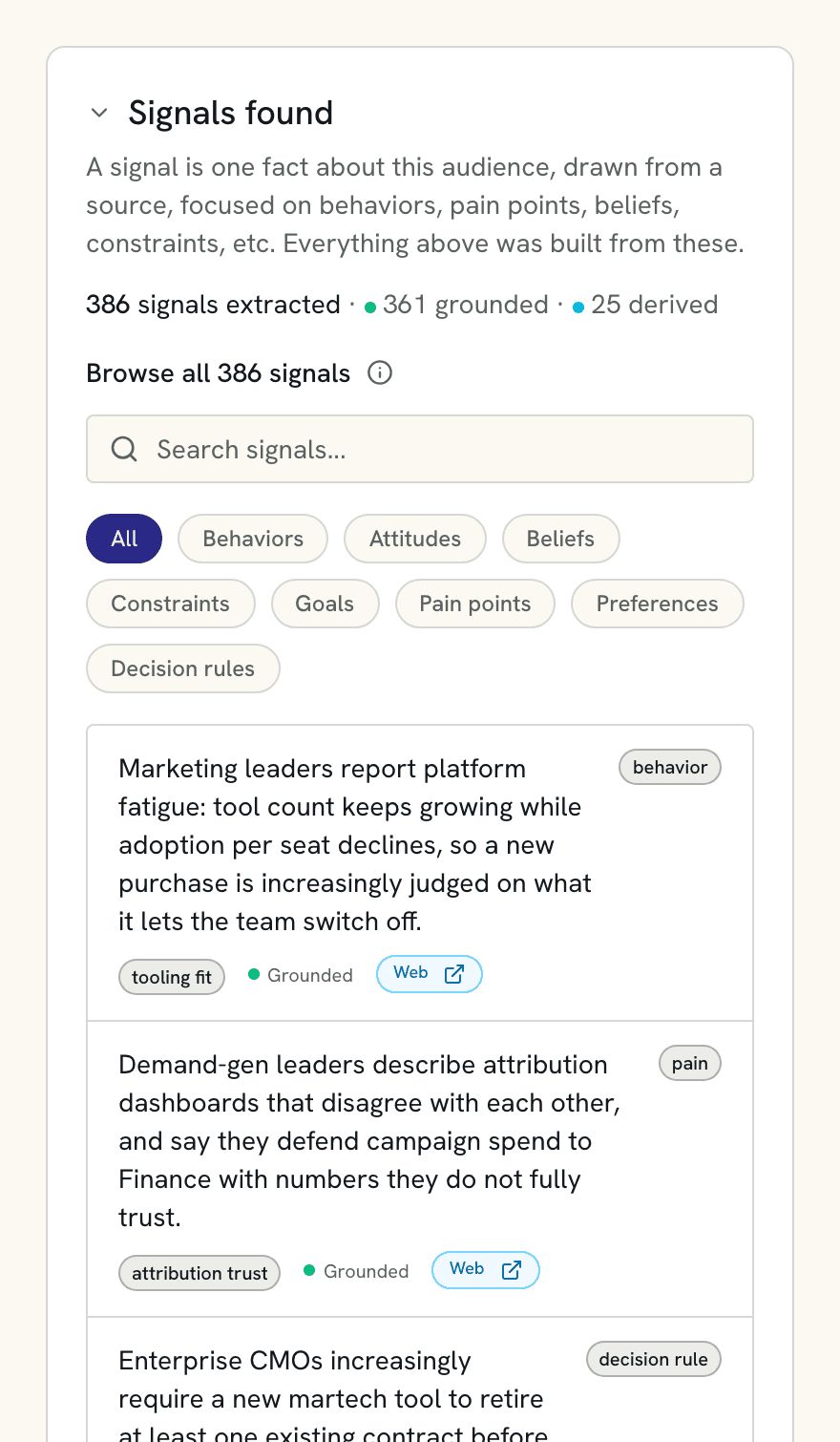
See how it worksTell Candor about your target audience: who they are, what they do, whatever matters. Upload any context documents or research you've already done, or start from scratch. Candor finds published evidence about this population and builds synthetic participants from it.
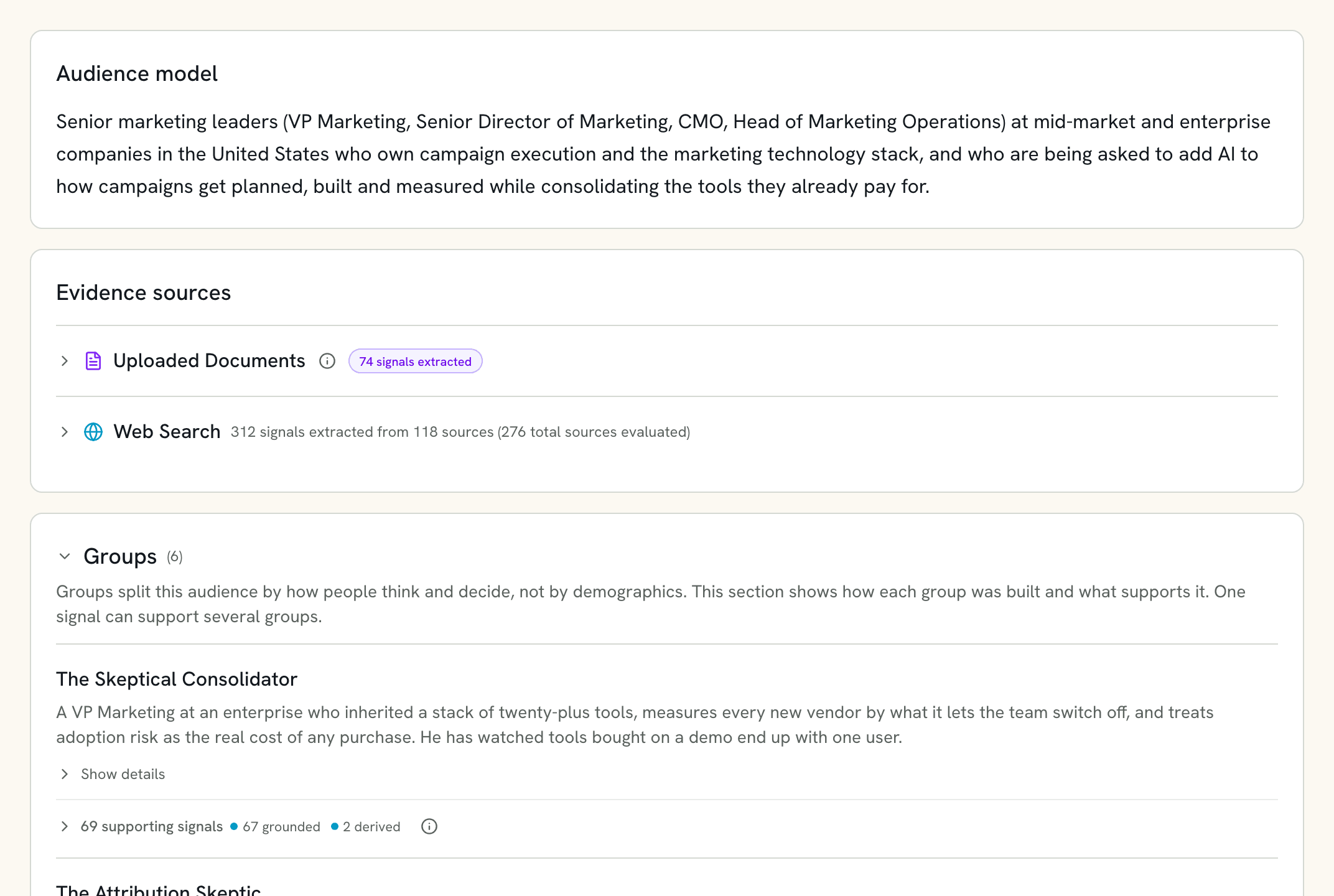
Participant attributes are labelled with the kind of evidence behind them, so you can see what you can check. How much evidence Candor has to work with depends on what you bring.
Describe your audience and Candor searches for published data: government statistics, industry reports, peer-reviewed research, professional association data. Specific, citable sources, not generic AI knowledge.
Customer interviews, support tickets, survey data, market reports, internal briefs, whatever you’ve already got. Your documents take priority over web evidence. The more context you bring, the sharper the participants.
You don’t need to know research methodology. Describe what you’re trying to figure out and Candor recommends a study type, builds the interview guide, and adapts the synthesis to match.
Surface the real pains, frustrations, and unmet needs before you scope a solution. Open-ended interviews with participants who hold their own context and push back on your assumptions.
Pressure-test whether a specific problem is real, painful, and worth building for. Cut the problems your team is over-indexed on. Surface the ones you missed.
Test a product, feature, name, value prop, or message before you commit. Find out which ideas resonate, which fall flat, and why. Cut the unpromising ones in hours.
Test a new tier, a packaging change, or a launch price before it goes live. See how different participants react and where willingness-to-pay breaks.
Candor’s interviewing methodology has been infused with research rigor from decades of research conducted across academia, UX, consulting, and venture building.
Try for FreeIt follows up uniquely per participant.
Most synthetic research tools invest in building the audience and then march every participant through the same questions in the same order. The interview is a formality between participant generation and the report.
It follows up uniquely per participant, lets go of the guide when the conversation goes somewhere interesting, and knows when a topic has been explored enough to move on instead of grinding through a checklist.
When a participant says something unexpected, Candor follows the thread. Some of the most valuable findings come from problems that weren't in the interview guide at all.
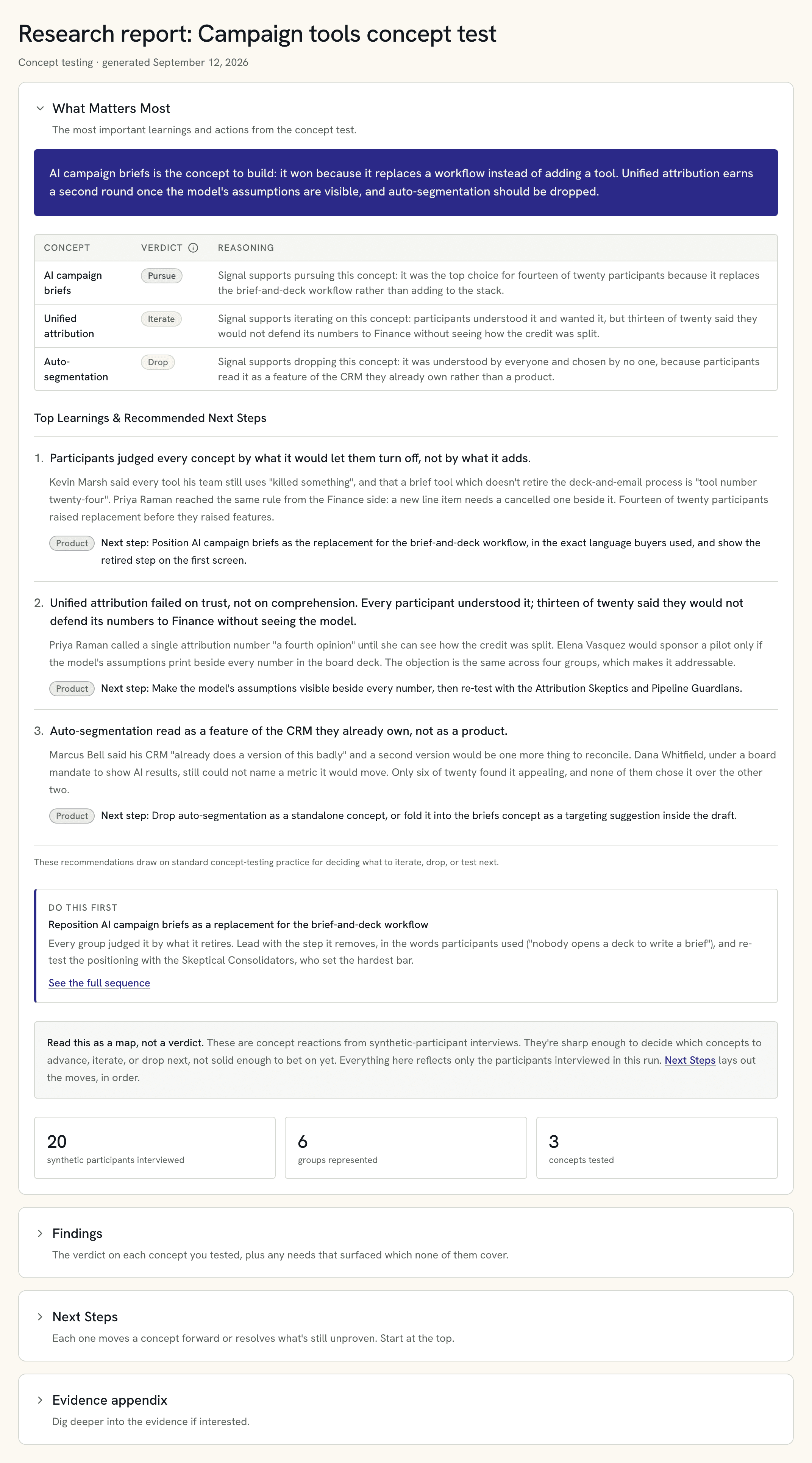
Candor synthesizes every interview into a clear report: what came through strongly, what didn’t, and where participants disagreed. The full interview transcripts come with the report, so you can check any finding against what was said.

What people are saying
“This is better than what I’ve gotten back from real user researchers working on a six-month project.”
Justin Smith · Senior Product Manager
“By far the best qualitative research tool I’ve used.”
Robyn Bolton · milezero
“We were surprised by how thoughtful the responses were, and we appreciated that everything was vetted with real evidence.”
Evan Tindle · Product Designer, AngelEye Health
A procurement lead evaluating enterprise software and a consumer making an impulse purchase don't think the same way. Candor models them with distinct personality profiles, decision frameworks, and buying triggers.
Interview a participant today. Return with a new concept whenever you're ready. They carry their earlier interviews with them: the stories they told, the opinions they shared, the decisions they described.
Real people don't agree with everything you say. Candor's participants hold positions, disagree with each other, and stay in character. No generic AI agreeableness.
A separate critic reviews every participant response against their prior statements and the underlying evidence. Contradictions get caught before they reach you.
Your researchers can run one study a week. You need five. Candor lets PMs interview synthetic respondents themselves, so researchers stay in the deep work that matters most.
Move at startup speed without skipping the work. Pressure-test concepts, value props, and pricing before you commit. Consultants: drop it into client engagements as a fast-validation layer.
Your team tests 10 to 50 concepts per project. Most get killed on internal judgment. Candor screens the unpromising ones in hours, so panel budget concentrates on the survivors.
Your stage gate is in three weeks. The research team can't get to it. Candor gives you decision-grade signal in hours, so you walk in with evidence.
Start with a free project, or walk through Candor with us first.

